Menstrual Health Is Mental Health: Why Women’s Wellbeing at Work Matters

Have you ever found yourself feeling more emotionally drained, easily overwhelmed, or less focused at work and only later realised it coincided with your menstrual cycle?
Many women experience subtle (and sometimes not-so-subtle) changes in mood, stress levels, and mental clarity during different phases of their cycle, yet these experiences are rarely acknowledged in the workplace.
Menstrual health is often treated as a private physical matter, something women are expected to manage quietly, without it affecting their professional lives. However, growing evidence suggests that menstrual-related symptoms can influence mental wellbeing, including stress response, emotional regulation, and psychological resilience at work. A recent large-scale study involving nearly 20,000 working women found that menstrual-related issues, including irregular cycles and common menstrual symptoms, were significantly associated with higher levels of psychological distress in the workplace. This highlights how menstrual health can intersect with mental wellbeing for women in professional settings.
Recognising menstrual health as part of mental wellbeing isn’t about turning a natural experience into a medical issue. It’s about understanding that hormonal changes can affect how women feel, think, and manage stress, especially in fast-paced or high-pressure work environments. When organisations acknowledge this, they can build more supportive workplace cultures and wellbeing initiatives that reflect real human experiences.
In this article, we’ll explore how the menstrual cycle can influence mental and emotional wellbeing, the lifestyle habits that can help support women at work, and the practical steps HR teams and leaders can take to create more inclusive and supportive workplaces.Why Lack of Confidence Is a Hidden Wellbeing Issue
Understanding the Mental & Emotional Impact of the Menstrual Cycle

For many women, changes in mood, focus, and stress levels don’t come out of nowhere. They follow a pattern.
You might notice that during certain weeks of the month, you feel more patient, focused, and mentally sharp. Work feels manageable, conversations feel easier, and decision-making comes naturally. Then, during other times, the same workload suddenly feels heavier. You may feel more easily overwhelmed, emotionally sensitive, or mentally drained, even though nothing at work has actually changed.
These shifts are often linked to hormonal changes across the menstrual cycle. Hormonal fluctuations can influence mood, stress response, motivation, and mental clarity, all of which play an important role in how women experience their workday.
How this can look across a typical month
Across a month, a woman’s body moves through different stages, and during each stage, energy levels, emotions, and mental resilience can feel different.
During menstruation, many women feel more fatigued, introspective, or emotionally sensitive. Concentration may be lower, patience can wear thin, and tasks that normally feel manageable can feel heavier. As the days progress, some women begin to experience a gradual sense of reset, but this phase often still calls for more rest, gentler pacing, and emotional support as the body recovers.
As the cycle progresses into the follicular phase, energy and focus often start to rise. Many women notice steadier emotions, clearer thinking, and higher confidence. This can be a time when work feels more manageable, creativity flows, and productivity is easier to maintain.
Around ovulation, energy and social confidence may peak. Women may feel more assertive, communicative, and motivated. This is often the time when presentations, collaborative projects, or tasks that require engagement and confidence feel more natural.
During the luteal phase, leading up to the next period, energy may gradually dip, and emotional sensitivity can increase. Stress may feel heavier, patience may shorten, and even routine tasks can feel more draining. Mindfulness, gentle movement, and balanced nutrition can help manage emotional and mental fluctuations.
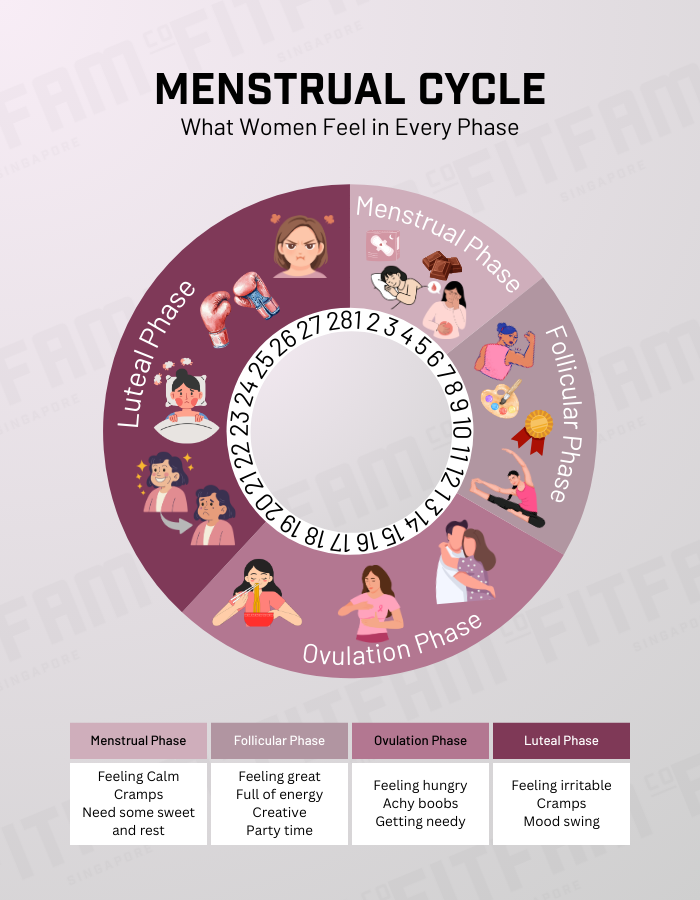
What’s important to understand is that these situations are part of a natural monthly rhythm that can influence how women feel, think, and cope, especially in demanding work environments.
Why this matters for mental wellbeing at work
Menstrual-related symptoms are linked with increased psychological distress, including higher levels of stress and anxiety among working women. This doesn’t mean every woman experiences the same symptoms, or that menstrual cycles limit capability. Instead, it highlights that mental wellbeing is not static, and for many women, it naturally fluctuates.
What often makes this harder is the unspoken expectation to perform at a constant level every single day, without acknowledging that mental energy, emotional resilience, and focus can change. When women feel pressure to “push through” silently, it can lead to increased stress, self-doubt, and burnout over time.
Recognising this connection isn’t about labelling or singling women out. It’s about normalising the reality that mental wellbeing is influenced by many factors, including hormonal changes and that supportive environments make a difference.
When workplaces understand that menstrual health can affect how women feel and cope mentally, they are better positioned to:
Respond with empathy rather than assumptions
Create psychologically safe environments
Support sustainable performance instead of short-term output
This awareness lays the foundation for more inclusive wellbeing conversations and opens the door to practical support through lifestyle habits and workplace initiatives, including strategies like workplace wellness programmes. Research reinforces why this matters. Studies on women’s experiences at work show that menstrual-related challenges, such as pain, fatigue, and limited workplace support, are linked to lower psychological wellbeing and a higher likelihood of wanting to avoid work during certain phases of the cycle. When these experiences are minimised or unsupported, the mental and emotional impact can intensify, affecting how women cope, perform, and sustain their wellbeing over time.
What HR and Leaders Can Do to Support Women’s Wellbeing
Menstrual wellbeing shouldn’t be treated as a niche issue, it’s part of whole-person wellbeing. For HR leaders and employers, acknowledging this can foster inclusive, supportive, and high-performing workplaces.
Here are practical ways organisations can step up:
1. Normalise Conversations
Creating psychologically safe spaces allows women to talk about wellbeing — including menstrual-related challenges — without fear of judgement or stigma. When these conversations are normalised, employees feel less pressure to “push through” silently, reducing stress and emotional strain. Over time, this builds trust and a more supportive workplace culture.
2. Integrate Inclusive Wellness Program
Wellness programs should acknowledge that mental wellbeing can be influenced by bodily experiences. This can include:
Education sessions on menstrual health and stress management
Mindfulness and mental resilience workshops
Movement & relaxation breaks as normalised practices
Resources on balanced nutrition for energy and mood support
3. Flexible Supportive HR Policies
Flexible scheduling or wellbeing breaks give employees practical ways to manage days when mental focus or emotional resilience is lower. Knowing these options exist reduces anxiety and helps women maintain performance without fear of being penalised. Supportive policies signal that wellbeing is taken seriously, not treated as an exception.
4. Training for Managers
Flexible scheduling or wellbeing breaks give employees practical ways to manage days when mental focus or emotional resilience is lower. Knowing these options exist reduces anxiety and helps women maintain performance without fear of being penalised. Supportive policies signal that wellbeing is taken seriously, not treated as an exception.
At FITFAMCO, we specialise in designing wellness programs that help companies achieve this in practice. Our corporate wellness solutions weave education, movement, mental resilience tools, and inclusive culture strategies into a cohesive program, helping HR teams understand and support women’s wellbeing in ways that feel thoughtful rather than forced.
Whether through tailored workshops for leaders, mental wellness talks, or ongoing wellbeing activities, FITFAMCO helps employers create environments where all employees, especially women navigating cyclical mental and emotional changes.
Conclusion
Menstrual health is deeply intertwined with mental and emotional wellbeing — and this matters in the workplace. Far from being a “personal issue,” menstrual wellbeing touches mood, stress, cognitive focus, productivity, and overall quality of life. Organisations that recognise and address this part of employee experience can foster workplaces where women feel supported, valued, and empowered.
Supporting women’s wellbeing begins with awareness and conversation. But it’s strengthened through intentional wellness strategies that recognise the whole human experience. For companies on this journey, FITFAMCO’s wellness initiatives provide actionable, compassionate support that aligns with both employee needs and organisational goals.