You’re Not Lazy—You’re Drained: How to Overcome Workplace Fatigue

Many employees today share a similar experience at work.
They feel tired before the day even fully begins. Tasks that used to feel manageable now take more effort. Focus comes and goes. Energy dips throughout the day, and by the time work ends, there’s little left (mentally or physically).
What’s more confusing is that this feeling doesn’t always go away with rest. Even after a full night’s sleep or a quiet evening, the same sense of fatigue lingers. It becomes easy to assume the problem is a lack of discipline or motivation.
But in most cases, that’s not the issue.
The problem isn’t that people aren’t trying hard enough—it’s that they’re running on low energy.
This experience is better understood as workplace fatigue, a state that affects both mental and physical functioning. And rather than pushing through it, the more effective approach is to understand what it is, why it happens, and how to address it in a sustainable way.
What Is Workplace Fatigue

Workplace fatigue is more than just feeling sleepy or needing a break. Research shows that fatigue is a biological and psychological state influenced by prolonged stress, workload, and insufficient recovery.
This means it doesn’t just affect how your body feels—it also affects how your mind functions.
You might notice it as:
difficulty concentrating
slower thinking
reduced motivation
or a general sense of low energy throughout the day
Importantly, workplace fatigue is not a personal failure. It is a natural response to sustained demands on both physical and mental energy.
In environments where employees are expected to stay focused, responsive, and productive for extended periods, fatigue becomes less of an exception and more of an expected outcome.
Understanding this shifts the narrative from “What’s wrong with me?” to “What is causing this, and how can it be managed?”
Why You Still Feel Tired At Work Even After Rest

One of the most frustrating parts of workplace fatigue is that rest doesn’t always seem to fix it. There are a few causes to this that we’ve listed down below:
Mental Fatigue Doesn’t Reset with Passive Rest
Even when you stop working, your mind may still be active—processing conversations, thinking about tasks, or anticipating what’s next. Because of this, passive forms of rest, such as scrolling on your phone or lying down without fully disconnecting, may not provide the recovery your brain actually needs.
Mental fatigue doesn’t go away just because you stop working—it requires the right kind of recovery.
Constant Cognitive Load Keeps You Drained
Another key factor is the way modern work is structured.
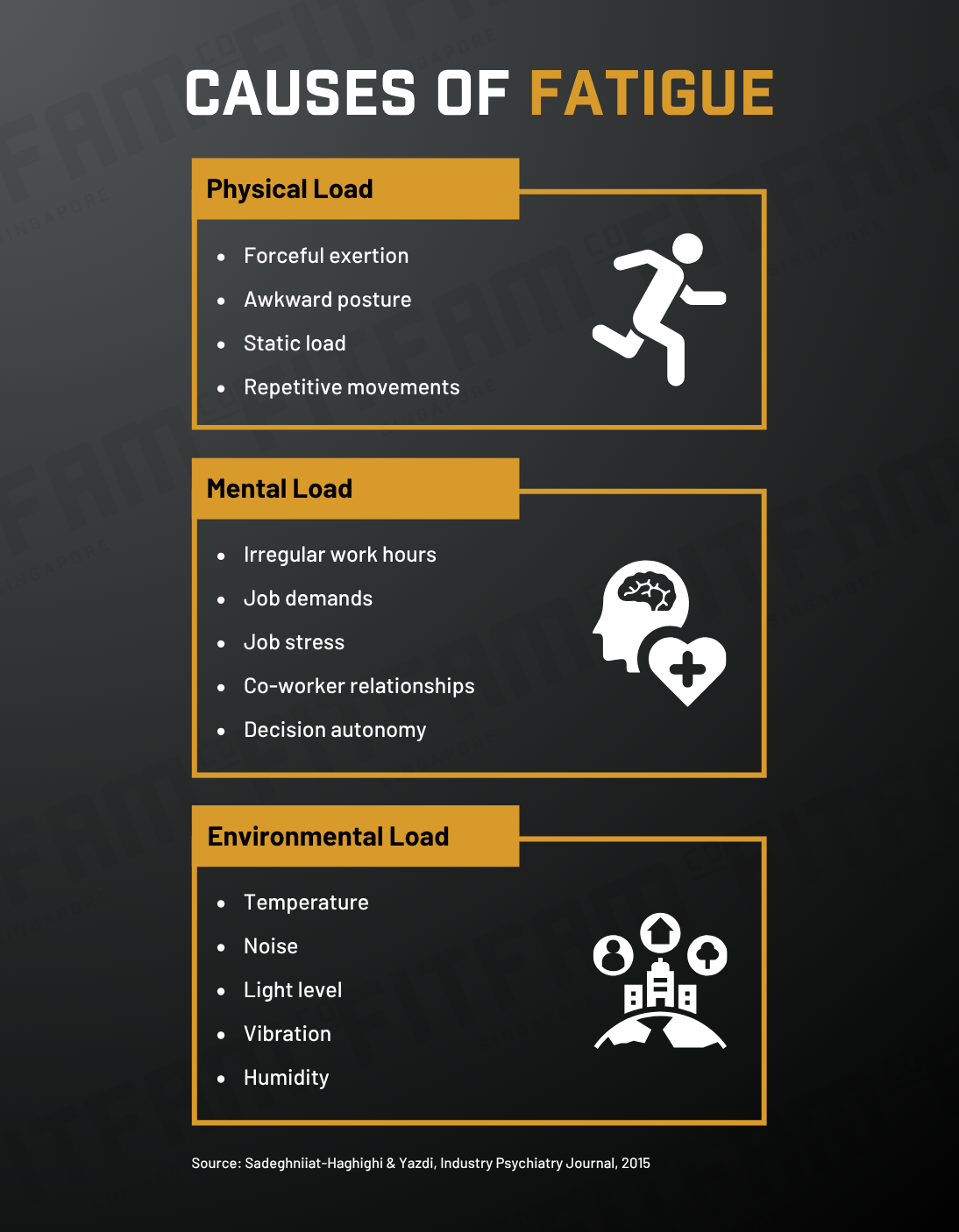
Many employees operate in environments where they are constantly “on”—responding to messages, attending meetings, switching between tasks, and making decisions throughout the day. Research shows that ongoing mental load and constant availability can lead to chronic stress, which is closely linked to fatigue and burnout.
This constant cognitive demand leaves little room for the brain to reset.
Over time, the accumulation of this mental load results in a persistent sense of exhaustion, even if the workload itself hasn’t dramatically increased.
Lack of True Recovery Throughout the Day
Fatigue also builds when there are no meaningful recovery periods.
Working for long stretches without breaks, staying in the same physical position, or relying only on passive rest can all contribute to declining energy levels. Sedentary behaviour, in particular, has been linked to reduced alertness and increased feelings of fatigue.
Without intentional recovery, fatigue doesn’t just remain, it accumulates.
5 Ways to Overcome Workplace Fatigue

Addressing workplace fatigue is not about doing more, but about doing things differently. Small, consistent changes can help restore energy and improve how both the body and mind function throughout the day.
1. Use Movement to Reset Your Energy
One of the most effective ways to counter fatigue is through movement.
Research suggests that fatigue improves when the body shifts state. Instead of remaining sedentary, incorporating light movement can help restore alertness, reduce physical tension, and improve overall energy levels.
This doesn’t require an intense workout. Simple actions such as:
stretching
short walks
or light mobility exercises
can make a noticeable difference. The key is to move, rather than remain still. Consider our personal training programs to help you incorporate regular movement into your routine and better manage fatigue.
2. Reduce Mental Overload
Fatigue also affects how the brain performs.
Studies show that fatigue can reduce concentration, slow reaction time, and impair decision-making. When mental load becomes too high, even simple tasks can start to feel overwhelming.
One way to address this is by reducing the amount of information your brain is processing at any given time.
This can include:
focusing on one task instead of multitasking
limiting unnecessary interruptions (e.g., use black out curtains, limit noise or use white noise for sleeping)
or organising tasks externally (e.g., writing them down instead of holding everything mentally)
Creating mental space and being more mindful allows the brain to function more efficiently and reduces the strain that contributes to fatigue. Explore our insights on practicing mindfulness and the art of being present here.
3. Improve Recovery Through Sleep and Boundaries
Recovery plays a central role in managing fatigue.
Without sufficient recovery, fatigue continues to build over time. Sleep is one of the most important factors, as it supports both physical restoration and cognitive function.
However, recovery is not just about sleep. It also involves creating boundaries that allow you to disconnect from work. This might include:
limiting work-related communication after hours
setting clear start and end times for the workday
or creating small moments of disconnection throughout the day
These practices help prevent fatigue from becoming chronic.
4. Educating Yourself About Sleep Matters
Improving fatigue management starts with understanding how sleep influences your body and mind. When you understand how sleep impacts your energy, mood, and focus, it becomes easier to build sustainable habits and recognise early signs of fatigue before they start affecting your day.
Having access to the right guidance can make this process more practical. At FITFAMCO, we hold wellness talks in workplaces like ‘Sleep Right, Live Bright’, designed to turn these insights into simple, actionable strategies, helping you and your co-workers improve your sleep habits and support your overall wellbeing.
5. Fuel Your Body with Better Nutrition
What you eat throughout the day also plays a key role in how you feel and function at work.
When fatigue builds up, it’s common to rely on quick, convenient options or to turn to food as a way to cope with stress. While this can provide short-term comfort, it often doesn’t support sustained energy. In many cases, it can lead to energy crashes later in the day, making fatigue feel even worse.
Instead, focusing on more balanced and consistent eating habits can help support stable energy levels, better concentration, and overall wellbeing. Simple changes, such as not skipping meals, staying hydrated, and choosing more nutrient-dense options, can make a noticeable difference over time.
If you’re unsure where to start, structured support can help make these changes more practical. You can also consider FITFAMCO’s nutrition coaching programs to build sustainable eating habits that support your energy, recovery, and daily performance.
Why This Matters for You at Work
While fatigue is something you feel personally, its effects often show up in your day-to-day work in ways that are hard to ignore.
Workplace fatigue can affect your:
productivity
performance
communication
When you’re fatigued, it becomes harder to concentrate, make decisions, and stay engaged throughout the day. Tasks may take longer than usual, small mistakes become more common, and even simple interactions can feel more draining.
Over time, this doesn’t just affect how you work—it can also impact how you feel. Constant fatigue can lead to frustration, reduced motivation, and a sense of being overwhelmed, especially when it feels like you’re trying your best but still running low on energy.
That’s why fatigue isn’t just something to “push through.” It’s something that needs to be understood and managed.
Doing that often requires more than just knowing the problem exists. Having access to the right support, whether through practical strategies, guided sessions, or structured wellness programs, can make it easier to manage energy, improve recovery, and feel more in control of your workday. Want to bring these solutions into your workplace? You can also share FITFAMCO with your HR team to explore available corporate wellness programs.
Conclusion
Workplace fatigue is often misunderstood.
It is not a sign of laziness or lack of motivation, but a signal that the body and mind are under sustained demand without sufficient recovery. Left unaddressed, it can affect not only how you feel, but how you perform and engage at work.
The good news is that fatigue can be managed.
By incorporating active strategies such as movement, reducing mental overload, improving recovery habits, and educating oneself of sleep matters, you can regain a sense of energy and control in your workday.
Ultimately, supporting workplace wellbeing is not about doing less—it is about doing things more intentionally and sustainably.