Return-to-Work Anxiety: 10 Tips for Employees and HR

We’ve all been there. You’ve spent the last few days recovering from an illness, and while your body is finally healing, a new symptom starts to kick in: Return-to-Work Anxiety. Unread emails, missed updates, and the pressure to immediately perform at full capacity.
But here’s the truth: A Medical Certificate (MC) treats your illness, but it doesn’t plan your recovery. A smooth return requires intention and strategy. Whether you’re an employee managing post-leave anxiety or an HR leader supporting your team, this article shares 10 practical tips to help bridge the gap between rest and results.
Why "Return-to-Work Anxiety" Happens
Anxiety in the workplace isn’t a new concept. In fact, for many professionals, work anxiety is the silent background noise of their careers. You can understand more about anxiety at work from our other blog here, and discover how to manage workplace anxiety.
However, when you’ve been away on medical leave, this general anxiety gets magnified. You aren't just dealing with your normal workload; you are dealing with the accumulated pressure of everything that happened while you were gone. This creates a specific "clash" between your recovering body and your racing mind.
This magnification usually shows up in these five specific ways:
The "Inbox Shadow": Visualizing the mountain of unread emails before you even open your laptop. This makes many people feel forced to work even while they are still on leave.
The Need to "Prove" You’re Better: Feeling a cultural pressure to work twice as hard on day 1 to show you aren’t "weak,".
Workplace FOMO: The fear that projects moved on without you or decisions were made in your absence, making you feel "out of the loop" or irrelevant.
Brain Fog & Low Stamina: Your body might feel okay, but your "mental battery" is still in low-power mode. Focusing on complex tasks for 8 hours straight becomes exhausting.
The "Explanation Tax": The mental drain of having to repeat your "sick story" to every colleague you meet in the pantry or at the desk.
The good news? The first 72 hours of return to work are the most important. If you manage them right, the rest of the week becomes easier.
Laboratory research shows that psychological stressors—including performance expectations and social evaluation—trigger measurable increases in cortisol, the body’s primary stress hormone, even before and during stressful tasks. During this early return period, stress levels tend to spike as you face backlog and pressure all at once. To support your return further, we’ve also written a blog that explains about workplace stress to help you understand that stress won’t vanish overnight, but there are ways to manage and relieve it.
10 Practical Tips for a Smooth Return to Work
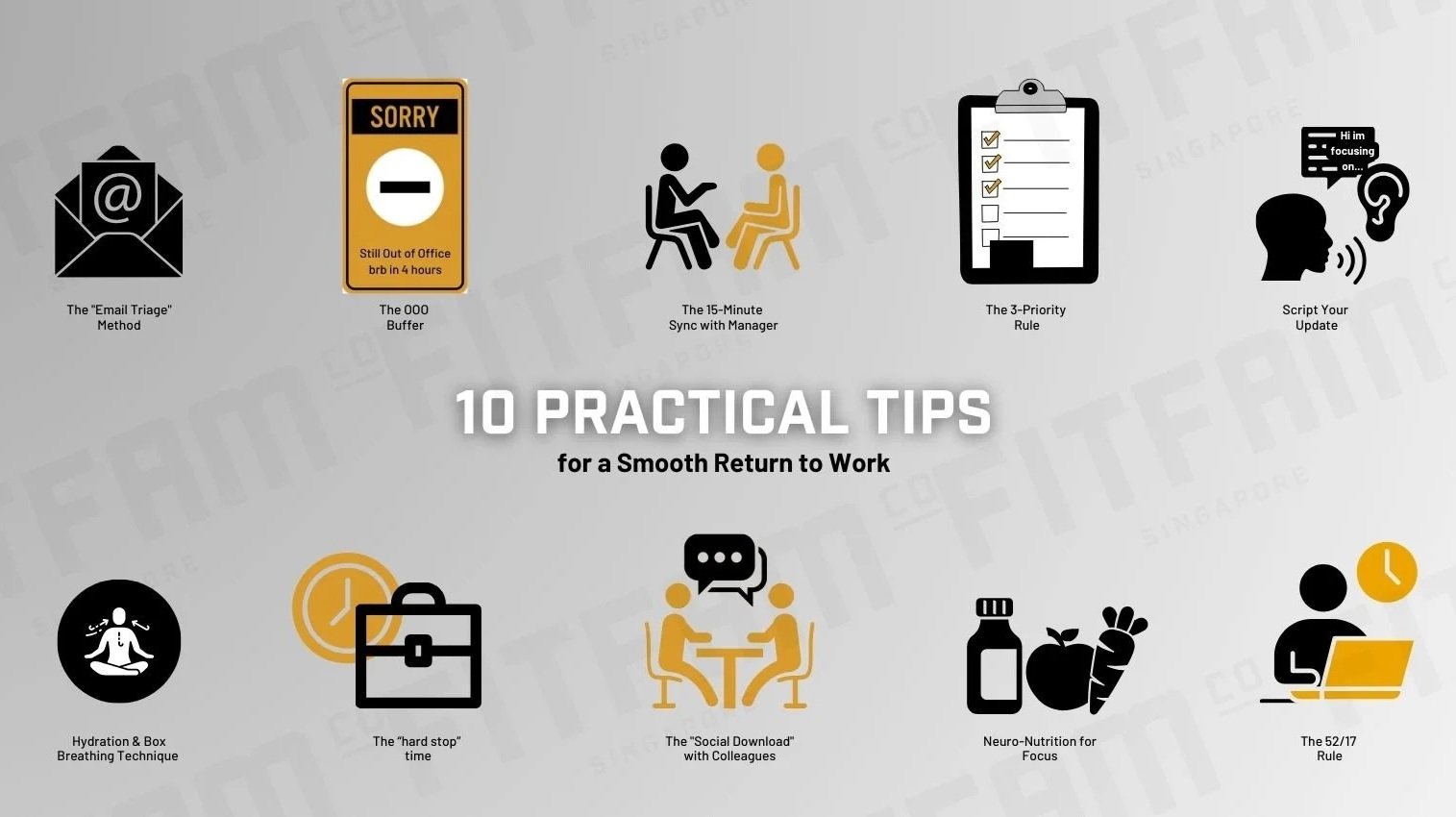
You don't have to guess how to handle this transition. By following a structured plan, you can quiet the noise in your head and focus on what truly moves the needle. To help you navigate this "re-entry" phase with clarity and confidence, we’ve put together a consolidated roadmap for your first few days back.
1. The "Email Triage" Method
Don’t read emails from oldest to newest. Filter by "Sender" (Boss/VIPs) or "Subject." Always read the last email in a thread first, usually, the problem was already solved while you were away!
2. The OOO Buffer
Keep your "Out of Office" auto-reply on for the first 4 hours of your first day. This gives you a "quiet zone" to sync up without people expecting instant replies.
3. The 3-Priority Rule
You cannot do everything at once. Pick exactly three non-negotiable tasks for Day 1. If you finish them, great. If not, that’s okay too.
4. The 15-Minute Sync:
Have a quick coffee with your manager. Don’t wait for them to come to you. Ask: "What moved while I was away, and what is the #1 priority for me TODAY?"
5. Script Your Update
Prepare a one-sentence reply for health questions so you don't have to over-explain. “I’m much better now, thank you! Just focusing on catching up with the [Project Name] today.”
6. The 52/17 Rule
Avoid the afternoon crash. Use a timer: work for 52 minutes, then take 17 minutes of "Micro-Downtime" (no screens, no phone) to let your brain reset.
7. Neuro-Nutrition for Focus
Our brain needs stable energy. Opt for Omega-3s and light meals (like sliced fish soup or walnuts) over heavy carbs to keep your focus sharp without the "food coma."
8. The "Social Download"
Catch up with a work-buddy for 10 minutes. Getting the "office tea" or informal project updates helps you feel "in the loop" again.
9. The “hard stop” time
No overtime for the first week. Your body needs consistent evening rest to ensure you stay healthy for the long run.
10. Hydration & Box Breathing
Stress spikes your cortisol levels. Drink plenty of water and try Box Breathing (Inhale 4s, Hold 4s, Exhale 4s, Hold 4s) when the backlog feels overwhelming.
How HR Can Support a Healthy Return

For HR professionals and managers, supporting an employee's return isn't just "being nice"—it’s a smart business investment that reduces turnover.
1. Normalize a "Phased Return"
In some professional businesses, we often expect 100% output immediately. Instead, try the 70% Workload Rule. Allow the employee to operate at 70% capacity for the first 3 days. Research shows that this "soft landing" prevents people from taking a second MC later in the month.
2. Set Clear Re-entry Expectations
A manager's most helpful phrase is: "Don't worry about that right now." Telling an employee what not to focus on is just as important as giving them a task list.
3. Empathy + Clarity > Pressure
Train your managers to have "Return-to-Work" conversations that focus on empathy. When an employee feels supported, their loyalty and engagement levels skyrocket. When you remove the pressure and give them a clear path, they get back to full speed much faster without the risk of burning out.
4. Offer Wellness Touch-points
Provide your team with the tools they actually need to stay strong and focused. Instead of just a "get well soon" card, give them practical ways to recover while they work. This could look like:
Mental Wellness Talks: To help employees manage that "backlog anxiety" and office stress.
Nutrition Workshops: Teaching the team about "Eating for Energy" so they can beat the afternoon slump without relying on sugar.
Stretch & Mobility Sessions: Simple, desk-friendly movements to help the body transition from bed rest back to the office chair.
At Fitfamco, we help HR teams plan Employee Engagement activities specifically designed to support these transitions. We move beyond "checking a box" to help you create a workplace where returning employees and also their colleagues, can thrive together. Check out our wellness program here.
Conclusion
At the end of the day, returning to work after a medical leave is about building momentum, not winning a sprint.
A quick recap for a smooth return:
For professionals: Remember that an MC covers the illness, but you need a plan for the recovery. Treat your first three days as a transition period, not a sprint.
For HR & Managers: Trade pressure for Kindness + Focus. A supportive first week back prevents burnout and builds lasting employee loyalty.
The Big Picture: Success isn't about how fast you reply to emails on Day 1; it’s about staying healthy enough to keep performing on Day 30.
Whether you are the one returning to your desk or the one welcoming a teammate back, remember that a smooth transition is a win for everyone.