
Having an employee wellness program doesn't automatically mean employees are becoming healthier, less stressed, or more engaged.
A company can offer fitness classes, wellness workshops and mental wellbeing sessions, yet still struggle with low employee engagement.
Often, the issue isn't that employees don't care about wellbeing, the program simply doesn't fit their needs or working reality. A lunchtime fitness class is easy to skip when meetings run back-to-back, while a stress workshop can feel like another task when deadlines are piling up.
Even a well-planned wellness program can miss the mark if it doesn't fit into employees' everyday work lives.
For HR and People & Culture teams, the bigger question isn't just whether employees showed up:
What makes an employee wellness program actually work?
And just as importantly, what causes one to fail?
In this article, we'll look at some of the common reasons employee wellness programs fail and what HR can do differently.
1. The Program Doesn't Address What Employees Actually Need

One of the most common mistakes is starting with the activity instead of the problem.
For example, a company might organise a fitness challenge because staying active is generally good for health. But if employees are currently struggling more with stress, poor sleep, unhealthy eating habits or work-life balance, the program may not feel particularly relevant to them.
This doesn't mean fitness activities aren't useful. It means the activity needs to connect with the actual needs of the workforce.
Singapore's Health Promotion Board (HPB) recommends uncovering employees' true health needs before selecting workplace health interventions. It also highlights the importance of maximising participation and evaluating programmes to understand their effectiveness.
How HR Can Fix It
Start with the employee's needs, rather than the wellness activity.
Before deciding what workplace wellness program to run, HR can ask:
What wellbeing challenges are employees experiencing?
What wellness activities have they participated in before?
Which programs did they find useful?
What prevents them from participating?
What topics would they actually like support with?
A short employee survey, pulse check or informal feedback session can help HR understand what employees are looking for.
The goal isn't to offer more wellness activities. It's to offer the right ones.
2. Employees Don't Have Enough Time to Participate

Even a relevant employee wellness program can fail when employees don't feel they have time for it.
Imagine an employee has back-to-back meetings all morning, a deadline in the afternoon and a full inbox waiting for them.
Then they receive an invitation for a one-hour wellness session during lunch.
Even if they think the session sounds useful, their first thought might be:
"I really should go, but I have too much work."
When wellness activities compete with deadlines, meetings and other responsibilities, participation can quickly become a lower priority.
How HR Can Fix It
Make the workplace wellness program as easy as possible to participate in.
Consider:
Offering shorter sessions where appropriate
Scheduling activities during working hours
Giving employees enough notice to plan around the activity
Offering flexible options that don't require everyone to participate at the same time or place. For example, a step challenge that employees can complete anytime and from anywhere
The easier it is to participate, the fewer barriers employees have to overcome.
3. Wellness Feels Like Another Task on the To-Do List

Just because a wellness activity is available doesn't mean employees will want to join it.
When employees are already busy, they need to see why it's worth making time for and how it can actually help them.
For HR, the question is simple: “Why would my employees want to take part?”
How HR Can Fix It
When promoting an employee wellness program, don't focus only on what the activity is. Help employees understand how it can make their workday or daily life a little easier.
For example:
Learn simple stretches to ease stiffness from sitting at your desk
Regulate your nervous system through breathing exercises
Cooking Demo: Easy meal prep for busy days
When employees can see how a wellness activity relates to something they experience every day, it feels less like another task on their calendar and more like something that could actually be useful to them.
If you want to explore more engaging wellness activity ideas, take a look at 10 Corporate Wellness Activities, based on FITFAMCO's 10 years of experience delivering workplace wellness programmes.
4. The Program Only Focuses on One Area of Wellness

Not everyone has the same definition of employee wellness.
One employee might love a lunchtime HIIT session. Another might prefer a nutrition workshop. Someone else may be more interested in stress management, mindfulness, mobility or mental wellbeing.
A workplace wellness program that focuses heavily on one area may therefore fail to connect with a wider group of employees.
How HR Can Fix It
Think about wellness as a broader strategy rather than a single type of activity.
Depending on your organisation's needs, this could include:
Physical Health
Activities that encourage employees to stay active and take care of their physical health.Mental Health
Support and activities that help employees manage stress, burnout, and mental wellbeing.Nutrition
Guidance and resources to help employees build healthier eating habits.Financial Wellness
Resources that help employees manage their finances and reduce financial stress.Social and Emotional Wellbeing
Activities that encourage connection, belonging, and emotional wellbeing.
Not sure how to structure your wellness plan across different areas? Check out our Wellness Plan Templates for HR for practical templates covering different pillars of employee wellbeing.
5. Employees Don't Feel Supported in Taking Time for Wellness

HR can tell employees that wellbeing matters, but what happens in the workplace often speaks louder than what is written in a wellness policy.
Do employees feel comfortable taking a break to join a wellness activity, or do they worry about falling behind on work?
Do managers encourage their teams to take part, or do meetings and deadlines always come first?
These everyday experiences shape how employees view wellness. If work always comes first, even a good wellness program can be hard to prioritise.
How HR Can Fix It
Make sure managers understand that participation in wellness activities is supported rather than treated as an inconvenience.
What HR can do:
Encourage managers to support employees attending wellness activities
Give managers clear talking points about the purpose of the program
Encourage leaders to respect scheduled wellness time
Avoid creating a culture where taking a break is viewed negatively
Make wellbeing part of everyday workplace conversations
A wellness program can provide the opportunity, but workplace culture can determine whether employees feel comfortable using it.
6. HR Measures Attendance Instead of Understanding Engagement

Attendance is useful.
But attendance alone doesn't tell HR whether an employee wellness program actually worked.
Suppose 100 employees attend a wellness workshop.
HR may also want to know:
Did employees find it relevant?
Did they enjoy the experience?
Would they participate again?
Did they learn something useful?
What would they like to see next?
Did employees who normally don't participate engage this time?
This is the difference between measuring participation and understanding employee engagement.
How HR Can Fix It
Look beyond attendance and collect feedback that can improve future wellness initiatives.
HR could track:
Reach
How many employees were exposed to the program?
Participation
How many registered or attended?
Experience
How did employees rate the session?
Relevance
Did employees feel the content addressed something useful to them?
Follow-through
Did they participate in another activity or engage with related resources?
Feedback
What did employees ask for next?
Over time, these insights can help HR understand which employee wellness programs are actually resonating and which ones need to change.
Want to go beyond participation and understand the bigger impact of your wellness investment? Learn more about how to measure the Return on Investment (ROI) of your workplace wellness program.
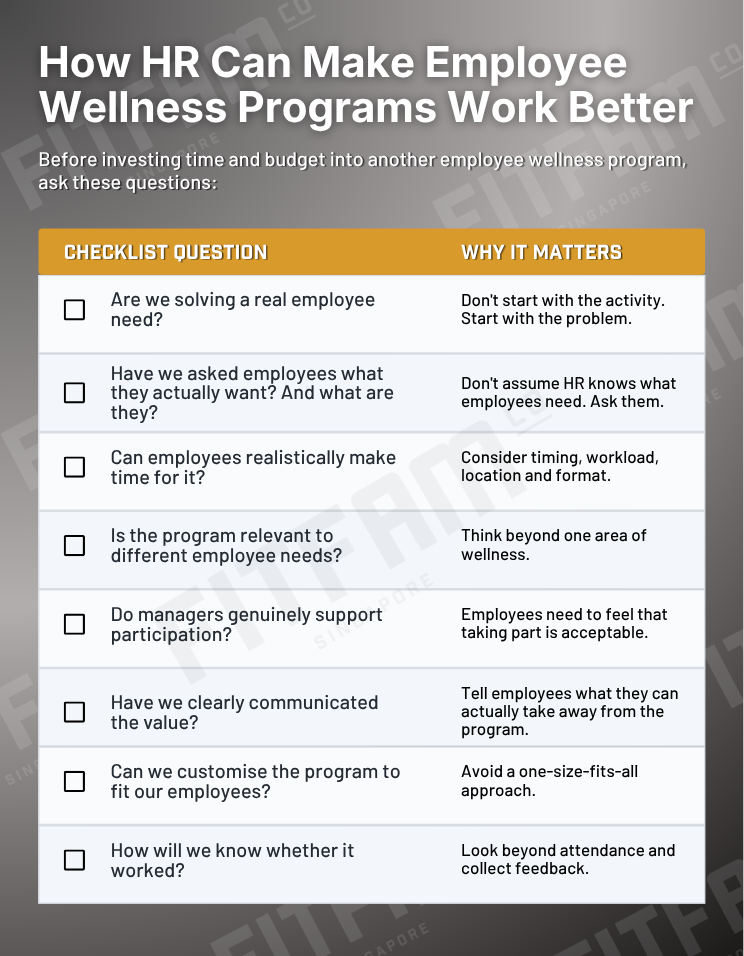
How HR Can Make Employee Wellness Program Work Better
Before launching your next employee wellness program, use this checklist to see whether it is designed around your employees rather than simply around an activity.
A Failed Employee Wellness Program Doesn't Mean Wellness Doesn't Work
When an employee wellness program gets low engagement, it doesn't necessarily mean employees aren't interested in wellness. It may simply mean the program needs to be more relevant, accessible, or better suited to how employees actually work.
A successful employee wellness strategy isn't about offering the most activities. It's about understanding your people, fitting wellness into their working lives, and adapting based on what they actually need.
Every workplace is different, and sometimes it takes a little trial and error to find what works for your people.
If you're not sure where to start, FITFAMCO can help you shape your ideas into a customised employee wellness program across fitness, nutrition and mental wellbeing based on what your employees actually need.
The goal is simple: make wellness practical, engaging and something employees can genuinely benefit from.